Showing posts with label Information Skills. Show all posts

Mind Maps


Mind Maps

A Powerful Approach to Note Taking
Related variants: Spray Diagrams, Spider Diagrams, Spidograms, Spidergrams and Mindmaps

Mind Map™ is a trade mark of the Buzan Organization

Mind Mapping is a useful technique that improves the way you take notes, and supports and enhances your creative problem solving.

SpacerSpacer
See how to construct a Mind Map.

By using Mind Maps, you can quickly identify and understand the structure of a subject, and the way that pieces of information fit together, as well as recording the raw facts contained in normal notes.

More than this, Mind Maps encourage creative problem solving, and they hold information in a format that your mind finds easy to remember and quick to review.

Popularized by Tony Buzan, Mind Maps abandon the list format of conventional note taking. They do this in favor of a two-dimensional structure. As such, a good Mind Map shows the 'shape' of the subject, the relative importance of individual points, and the way in which facts relate to one another.

Mind Maps are more compact than conventional notes, often taking up one side of paper. This helps you to make associations easily. And if you find out more information after you have drawn the main Mind Map, then you can easily add it in.

Mind Maps are also useful for:

  • Summarizing information.
  • Consolidating information from different research sources.
  • Thinking through complex problems.
  • Presenting information in a format that shows the overall structure of your subject.

What's more, they are very quick to review as you can often refresh information in your mind just by glancing at one. In the same way, they can be effective mnemonics: Remembering the shape and structure of a Mind Map can give you the cues you need to remember the information within it. As such, they engage much more of your brain in the process of assimilating and connecting facts, compared with conventional notes.

Drawing Simple Mind Maps

The original Mind Tools site was planned and researched using Mind Maps. They are too large to publish here, however part of one is shown below. This shows research into time management skills:

Figure 1: An Example Mind Map

To make notes on a subject using a Mind Map, draw it in the following way:

  1. Write the title of the subject you're exploring in the center of the page, and draw a circle around it. This is shown by the circle marked 1 in Figure 1, above.
  2. As you come across major subdivisions or subheadings of the topic (or important facts that relate to the subject) draw lines out from this circle. Label these lines with these subdivisions or subheadings. These are shown by the lines marked 2 in Figure 1.
  3. As you "burrow" into the subject and uncover another level of information (further subheadings, or individual facts) belonging to the subheadings above, draw these as lines linked to the subheading lines. These are shown by the lines marked 3 in Figure 1.
  4. Finally, for individual facts or ideas, draw lines out from the appropriate heading line and label them. These are shown by the lines marked 4 in Figure 1.

As you come across new information, link it in to the Mind Map appropriately.

A complete Mind Map may have main topic lines radiating in all directions from the center. Sub-topics and facts will branch off these, like branches and twigs from the trunk of a tree. You do not need to worry about the structure produced, as this will evolve as you develop your mind map.

Note that the idea of numbered 'levels' in Figure 1 is only used to explain how the Mind Map was created. All we are showing is that major headings radiate from the center, with lower level headings and facts branching off from the higher level headings.

While drawing Mind Maps by hand is appropriate in many cases, software tools like MindGenius improve the process by helping to you to produce presentation quality Concept Maps, which can easily be edited, distributed and redrafted.

Improving your Mind Maps

Once you understand how to make notes in the Mind Map format, you can develop your own conventions to take them further. The following suggestions may help to increase their effectiveness:
  • Use single words or simple phrases for information: Most words in normal writing are padding: They convey facts in the correct context, and in a format that is pleasant to read. In your own Mind Maps, single strong words and meaningful phrases can convey the same meaning more potently. Excess words just clutter the Mind Map.

  • Print words: Joined up or indistinct writing can be more difficult to read.

  • Use color to separate different ideas: This will help you to separate ideas where necessary. It also makes your Mind Map easier to remember. Color also helps to show the organization of the subject.

  • Use symbols and images: Where a symbol or picture means something to you, use it. Pictures can help you to remember information more effectively than words.

  • Using cross-linkages: Information in one part of the Mind Map may relate to another part. Here you can draw in lines to show the cross-linkages. This helps you to see how one part of the subject connects with another.

Click on the thumbnail below for a great example of a mind map that has extremely high visual impact.
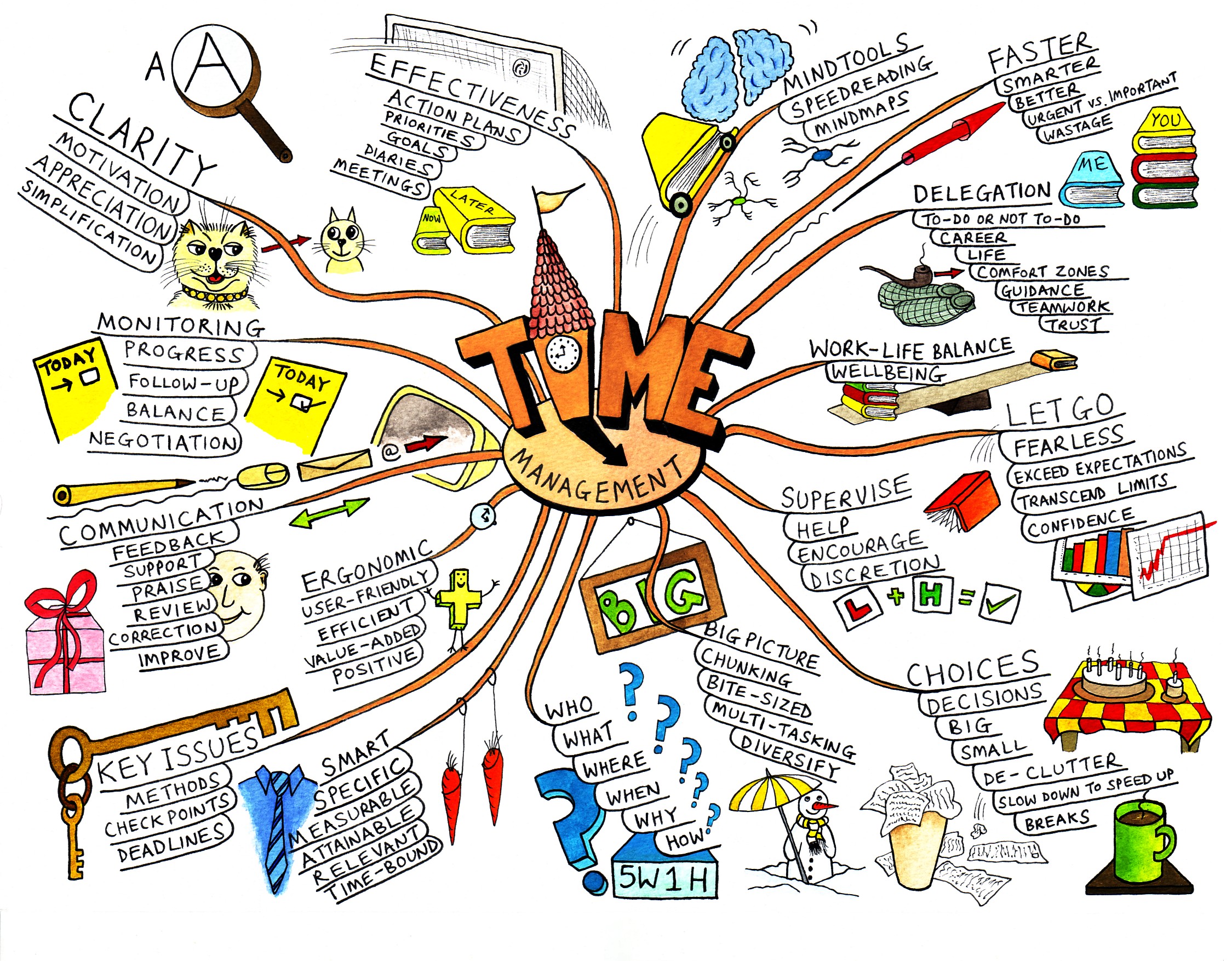
A high-impact mind map

Key points:

Mind Mapping is an extremely effective method of taking notes. Mind Maps show not only facts, but also the overall structure of a subject and the relative importance of individual parts of it. They help you to associate ideas and make connections that you might not otherwise make.

If you do any form of research or note taking, try experimenting with Mind Maps. You will find them incredibly useful!

Memory Improvement techniques

Avoid frustrating memory loss. Retain and recall more information.


It's a classic situation - you meet someone new, and then moments later you've forgotten their name! Names, passwords, pin and telephone numbers... the list is endless - with so much to memorize is it really possible to improve how much you can remember?

The good news is "yes"! Just like every muscle in your body, the adage "use it or lose it" applies, so the more you exercise your brain, the more you will remember.


Mnemonics
‘Mnemonic’ is another word for memory tool. Mnemonics are techniques for remembering information that is otherwise quite difficult to recall: A very simple example is the ‘30 days hath September’ rhyme for remembering the number of days in each calendar month.

The idea behind using mnemonics is to encode difficult-to-remember information in a way that is much easier to remember.

Our brains evolved to code and interpret complex stimuli such as images, colors, structures, sounds, smells, tastes, touch, positions, emotions and language. We use these to make sophisticated models of the world we live in. Our memories store all of these very effectively.

Unfortunately, a lot of the information we have to remember in modern life is presented differently – as words printed on a page. While writing is a rich and sophisticated medium for conveying complex arguments, our brains do not easily encode written information, making it difficult to remember.

Using Your Whole Mind to Remember
The key idea is that by coding information using vivid mental images, you can reliably code both information and the structure of information. And because the images are vivid, they are easy to recall when you need them.

The techniques explained later on in this section show you how to code information vividly, using stories, strong mental images, familiar journeys, and so on.

You can do the following things to make your mnemonics more memorable:

Use positive, pleasant images. Your brain often blocks out unpleasant ones.
Use vivid, colorful, sense-laden images – these are easier to remember than drab ones.
Use all your senses to code information or dress up an image. Remember that your mnemonic can contain sounds, smells, tastes, touch, movements and feelings as well as pictures.
Give your image three dimensions, movement and space to make it more vivid. You can use movement either to maintain the flow of association, or to help you to remember actions.
Exaggerate the size of important parts of the image.
Use humor! Funny or peculiar things are easier to remember than normal ones.
Similarly, rude rhymes are very difficult to forget!
Symbols (red traffic lights, pointing fingers, road signs, etc.) can code quite complex messages quickly and effectively.
Designing Mnemonics: Imagination, Association and Location
The three fundamental principles underlying the use of mnemonics are imagination, association and location. Working together, you can use these principles to generate powerful mnemonic systems.

Imagination: is what you use to create and strengthen the associations needed to create effective mnemonics. Your imagination is what you use to create mnemonics that are potent for you. The more strongly you imagine and visualize a situation, the more effectively it will stick in your mind for later recall. The imagery you use in your mnemonics can be as violent, vivid, or sensual as you like, as long as it helps you to remember.

Association: this is the method by which you link a thing to be remembered to a way of remembering it. You can create associations by:

Placing things on top of each other.
Crashing things together.
Merging images together.
Wrapping them around each other.
Rotating them around each other or having them dancing together.
Linking them using the same color, smell, shape, or feeling.
As an example, you might link the number 1 with a goldfish by visualizing a 1-shaped spear being used to spear it.

Location: gives you two things: a coherent context into which you can place information so that it hangs together, and a way of separating one mnemonic from another. By setting one mnemonic in a particular town, I can separate it from a similar mnemonic set in a city. For example, by setting one in Wimbledon and another similar mnemonic with images of Manhattan, we can separate them with no danger of confusion. You can build the flavors and atmosphere of these places into your mnemonics to strengthen the feeling of location.
Making learning a happier experience


Also called the "Conscious Competence Matrix" and the "Learning Matrix"
When we find that we don’t know something important, we’re often motivated to learn more. However if we’re blissfully unaware of our ignorance, there’s little we can do about it.

One of the first steps on the journey to acquiring new skills is therefore to be aware of what you don’t know. This discovery can be uncomfortable, as can be the experience of not being very good at what you’re trying to do (as you won’t be, when you first start to learn.)

The Conscious Competence Ladder is a popular and intuitive approach (attributed to many different possible originators) that helps us manage our own emotions during a sometimes dispiriting learning process. More than this, it helps us to be more in touch with the emotions of the people we are teaching, so we can better coach them through the learning process.

Explaining the Model:
According to this approach, consciousness is the first step towards gaining knowledge. To learn new skills and to gain knowledge you need to be conscious of what you do and do not know.

Next, competence is your ability to do things. You may be highly competent in one area, but have no skill in another. Your competence level will depend on the task or job at hand.

The idea is that as you build expertise in a new area, you move from "unconscious incompetence" to "conscious incompetence" and then to "conscious competence", finally reaching "unconscious competence." These are explained below, and this "ladder" of learning is shown in figure 1.


Level 1 - Unconscious Incompetence
(You Don't Know that You Don't Know)
At this level you are blissfully ignorant: You have a complete lack of knowledge and skills in the subject in question. On top of this, you are unaware of this lack of skill, and your confidence may therefore far exceed your abilities.

Level 2 - Conscious Incompetence
(You Know that You Don't Know)
At this level you find that there are skills you need to learn, and you may be shocked to discover that there are others who are much more competent than you. As you realize that your ability is limited, your confidence drops. You go through an uncomfortable period as you learn these new skills when others are much more competent and successful than you are.

Level 3 - Conscious Competence
(You Know that You Know)
At this level you acquire the new skills and knowledge. You put your learning into practice and you gain confidence in carrying out the tasks or jobs involved. You are aware of your new skills and work on refining them.

You are still concentrating on the performance of these activities, but as you get ever-more practice and experience, these become increasingly automatic.

Level 4 - Unconscious Competence
(You Don't Know that You Know - It Just Seems Easy!)
At this level your new skills become habits, and you perform the task without conscious effort and with automatic ease. This is the peak of your confidence and ability.

Tip:
Some people prefer to think of this as a matrix (hence "Conscious Competence Matrix" or "Learning Matrix") with Incompetence/Competence on the horizontal axis, and Unconscious/Conscious on the vertical axis


Using the Tool:
The Conscious Competence Ladder helps us in two ways: It gives us reassurance when we need it, and it helps us coach others through a sometimes difficult learning process.

During the Conscious Incompetence phase, we have the reassurance that while things are difficult and frustrating right now, things will get much better in the future. And when we're at the stage of Unconscious Competence, the model reminds us to value the skills we have so painstakingly acquired.

As an approach to coaching others, it reminds us that people may be moving through these steps as they learn the new skills we're trying to teach them:

Unconscious Incompetence: At the beginning of the process, they may be unaware of their own lack of competence, and may need to be made gently aware of how much they need to learn.


Conscious Incompetence: During this stage, you'll need to provide plenty of encouragement, tolerate mistakes appropriately, and do what you can to help people improve.


Conscious Competence: At this stage you need to keep people focused on effective performance of the task, and give plenty of opportunities for them to get practice.


Unconscious Competence: Although this is the ideal state, you'll need to make sure that people avoid complacency, and stay abreast of their fields. You may also need to remind people how difficult it was to reach this state, so that they are tolerant with people at the Conscious Incompetence stage!
Learn Effectively by Understanding Your Learning Preferences

Have you ever tried to learn something fairly simple, yet failed to grasp the key ideas? Or tried to teach people and found that some were overwhelmed or confused by something quite basic?

If so, you may have experienced a clash of learning styles: Your learning preferences and those of your instructor or audience may not have been aligned. When this occurs, not only is it frustrating for everyone, the communication process breaks down and learning fails.

Once you know your own natural learning preference, you can work on expanding the way you learn, so that you can learn in other ways, not just in your preferred style.

And, by understanding learning styles, you can learn to create an environment in which everyone can learn from you, not just those who use your preferred style.

Felder and Silverman's Index of Learning Styles
One of the most widely used models of learning styles is the Index of Learning Styles developed by Richard Felder and Linda Silverman in the late 1980s. According to this model (which Felder revised in 2002) there are four dimensions of learning styles. Think of these dimensions as a continuum with one learning preference on the far left and the other on the far right.

Figure 1: Learning Styles Index

Sensory Intuitive

Sensory learners prefer concrete, practical, and procedural information. They look for the facts. Intuitive learners prefer conceptual, innovative, and theoretical information. They look for the meaning.

Visual
Verbal

Visual learners prefer graphs, pictures, and diagrams. They look for visual representations of information. Verbal learners prefer to hear or read information. They look for explanations with words.

Active
Reflective

Active learners prefer to manipulate objects, do physical experiments, and learn by trying. They enjoy working in groups to figure out problems. Reflective learners prefer to think things through, to evaluate options, and learn by analysis. They enjoy figuring out a problem on their own.

Sequential Global

Sequential learners prefer to have information presented linearly and in an orderly manner. They put together the details in order to understand the big picture emerges. Global learners prefer a holistic and systematic approach. They see the big picture first and then fill in the details.


Once you know where your preferences lie on each of these dimensions, you can begin to stretch beyond those preferences and develop a more balanced approach to learning. Not only will you improve your learning effectiveness, you will open yourself up to many different ways of perceiving the world.

Balance is key. You don't want to get too far on any one side of the learning dimensions. When you do that you limit your ability to take in new information and make sense of it quickly, accurately, and effectively.

Tip:
This article describes one useful approach to learning styles. Other practitioners have different approaches.

See our article on 4MAT to find out about other useful approaches: Those of David Kolb, and of Peter Honey and Alan Mumford. And click here to find out about other styles.


Using the Learning Style Index
You can use the learning style index to develop your own learning skills and also to help you create a rounded learning experience for other people.

(I) Developing Your Learning Skills

Step One:
Identify your learning preferences for each learning dimension. Read through the explanations of each learning preference and choose the one that best reflects your style. Alternatively, use an Index of Learning Styles Questionnaire like the one at http://www.engr.ncsu.edu/learningstyles/ilsweb.html.

Step Two:
Analyze your results and identify those dimensions where you are "out of balance," meaning you have a very strong preference for one style and dislike the other.

Step Three:
For each out of balance area, use the information in figure 2 to improve your skills in areas where you need development.

Figure 2: Bringing Your Learning Styles Into Balance

Sensory Learners - if you rely too much on sensing, you can tend to prefer what is familiar, and concentrate on facts you know instead of being innovative and adapting to new situations. Seek out opportunities to learn theoretical information and then bring in facts to support or negate these theories.

Intuitive Learners - if you rely too much on intuition you risk missing important details, which can lead to poor decision-making and problem solving. Force yourself to learn facts or memorize data that will help you defend or criticize a theory or procedure you are working with. You may need to slow down and look at detail you would otherwise typically skim.

Visual Learners - if you concentrate more on pictorial or graphical information than on words, you put yourself at a distinct disadvantage because verbal and written information is still the main preferred choice for delivery of information. Practice your note taking and seek out opportunities to explain information to others using words.

Verbal Learners - when information is presented in diagrams, sketches, flow charts, and so on, it is designed to be understood quickly. If you can develop your skills in this area you can significantly reduce time spent learning and absorbing information. Look for opportunities to learn through audio-visual presentations (such as CD-ROM and Webcasts.) When making notes, group information according to concepts and then create visual links with arrows going to and from them. Take every opportunity you can to create charts and tables and diagrams.

Active Learners - if you act before you think you are apt to make hasty and potentially ill-informed judgments. You need to concentrate on summarizing situations, and taking time to sit by yourself to digest information you have been given before jumping in and discussing it with others.

Reflective Learners - if you think too much you risk doing nothing. ever. There comes a time when a decision has to be made or an action taken. Involve yourself in group decision-making whenever possible and try to apply the information you have in as practical a manner as possible.

Sequential Learners - when you break things down into small components you are often able to dive right into problem solving. This seems to be advantageous but can often be unproductive. Force yourself to slow down and understand why you are doing something and how it is connected to the overall purpose or objective. Ask yourself how your actions are going to help you in the long run. If you can't think of a practical application for what you are doing then stop and do some more "big picture" thinking.

Global Learners - if grasping the big picture is easy for you, then you can be at risk of wanting to run before you can walk. You see what is needed but may not take the time to learn how best to accomplish it. Take the time to ask for explanations, and force yourself to complete all problem-solving steps before coming to a conclusion or making a decision. If you can't explain what you have done and why, then you may have missed critical details.


(II) Creating a Rounded Learning Experience for Others

Whenever you are training or communicating with others, you have information and ideas that you want them to understand and learn effectively and efficiently. Your audience is likely to demonstrate a wide range of learning preferences, and your challenge is to provide variety that helps them learn quickly and well.

Your preferred teaching and communication methods may in fact be influenced by your own learning preferences. For example, if you prefer visual rather than verbal learning, you may in turn tend to provide a visual learning experience for your audience.

Be aware of your preferences and the range of preference of your audiences. Provide a balanced learning experience by:

Sensory - Intuitive: Provide both hard facts and general concepts.

Visual - Verbal: Incorporate both visual and verbal cues.

Active - Reflective: Allow both experiential learning and time for evaluation and analysis.

Sequential - Global: Provide detail in a structured way, as well as the big picture.

Key Points
Learning styles and preferences vary for each of us and in different situations.

By understanding this, and developing the skills that help you learn in a variety of ways, you make the most of your learning potential. And because you're better able to learn and gather information, you'll make better decisions and choose better courses of action.

And by understanding that other people can have quite different learning preferences, you can learn to communicate your message effectively in a way that many more people can understand. This is fundamentally important, particularly if you're a professional for whom communication is an important part of your job.

Take time to identify how you prefer to learn and then force yourself to break out of your comfort zone. Once you start learning in new ways you'll be amazed at how much more you catch and how much easier it is to assimilate information and make sense of what is going on.
Keeping Knowledge in Your Short-Term Memory

Normally people's memories of things they have learned are clearest immediately after they have learned them. They will then forget more and more knowledge as time goes on. After a few months they may only be able to recall only a tiny percentage of what was initially learned. This makes relearning information difficult when it needs to be done.

If you review knowledge frequently, however, then you will be able to keep it fresh and alive in your mind. This makes it easy to recall when you need it with a minimum of effort.

This section explains how to review material in a structured and effective way.

How to Use the Tool:
The first step is to spend a few minutes reviewing material immediately after the learning session. This helps you to:

Confirm that you understand the material
Reduce the time needed to relearn information when you need it, and
Improve the quality of future learning, by building on a well-remembered foundation. This helps your mind to make connections and linkages that it would not otherwise make.
A good way of carrying out this review is to rewrite or tidy up notes. You can do this effectively by putting the information learned into a Concept Map.

After this, reviewing information should be relatively easy and need not take long. Carry out reviews at the following times:

After one day

After one week

After one month

After four months

Review the topic by taking a few minutes to jot down everything you can remember about the subject, and compare this with your notes.

If you review information often, it should stay fresh in your mind, and will be easily accessible when you need it.

Key points:
By reviewing information you avoid forgetting information that will be difficult and time-consuming to relearn. You also ensure that you keep information fresh in your mind so that it acts as a foundation for future learning.

The first stage in reviewing information is to rewrite and tidy up notes immediately after learning has taken place. This confirms the structure and detail of information in your mind.

After this, periodically jot down what you can remember on a subject and compare it with your notes. This will show you what you have forgotten and refresh your memory.
Reading Efficiently by Reading Intelligently

Good reading strategies help you to read in a very efficient way. Using them, you aim to get the maximum benefit from your reading with the minimum effort. This section will show you how to use six different strategies to read intelligently.

Strategy 1: Knowing what you want to know
The first thing to ask yourself is: Why you are reading the text? Are you reading with a purpose or just for pleasure? What do you want to know after reading it?

Once you know this, you can examine the text to see whether it is going to move you towards this goal.

An easy way of doing this is to look at the introduction and the chapter headings. The introduction should let you know at whom the book is targeted, and what it seeks to achieve. Chapter headings will give you an overall view of the structure of the subject.

Ask yourself whether the book meets your needs. Ask yourself if it assumes too much or too little knowledge. If the book isn't ideal, would it be better to find a better one?

Strategy 2: Knowing how deeply to study the material
Where you only need the shallowest knowledge of the subject, you can skim material. Here you read only chapter headings, introductions and summaries.

If you need a moderate level of information on a subject, then you can scan the text. Here you read the chapter introductions and summaries in detail. You may then speed read the contents of the chapters, picking out and understanding key words and concepts. At this level of looking at the document it is worth paying attention to diagrams and graphs.

Only when you need detailed knowledge of a subject is it worth studying the text. Here it is best to skim the material first to get an overview of the subject. This gives you an understanding of its structure, into which you can fit the detail gained from a full, receptive reading of the material. SQ3R is a good technique for getting a deep understanding of a text.

Strategy 3: Active Reading
When you are reading a document in detail, it often helps if you highlight, underline and annotate it as you go on. This emphasizes information in your mind, and helps you to review important points later.

Doing this also helps to keep your mind focused on the material and stops it wandering.

This is obviously only something to do if you own the document! If you own the book and find that active reading helps, then it may be worth photocopying information in more expensive texts. You can then read and mark the photocopies.

If you are worried about destroying the material, ask yourself how much your investment of time is worth. If the benefit you get by active reading reasonably exceeds the value of the book, then the book is disposable.

Strategy 4: How to study different sorts of material
Different sorts of documents hold information in different places and in different ways. They have different depths and breadths of coverage. By understanding the layout of the material you are reading, you can extract useful information much more efficiently.

Reading Magazines and Newspapers:
These tend to give a very fragmented coverage of an area. They will typically only concentrate on the most interesting and glamorous parts of a topic - this helps them to sell copies! They will often ignore less interesting information that may be essential to a full understanding of a subject. Typically areas of useful information are padded out with large amounts of irrelevant waffle or with advertising.

The most effective way of getting information from magazines is to scan the contents tables or indexes and turn directly to interesting articles. If you find an article useful, then cut it out and file it in a folder specifically covering that sort of information. In this way you will build up sets of related articles that may begin to explain the subject.

Newspapers tend to be arranged in sections. If you read a paper often, you can learn quickly which sections are useful and which ones you can skip altogether.

Reading Individual Articles:
Articles within newspapers and magazines tend to be in three main types:

News Articles:
Here the most important information is presented first, with information being less and less useful as the article progresses. News articles are designed to explain the key points first, and then flesh them out with detail.
Opinion Articles:
Opinion articles present a point of view. Here the most important information is contained in the introduction and the summary, with the middle of the article containing supporting arguments.
Feature Articles:
These are written to provide entertainment or background on a subject. Typically the most important information is in the body of the text.
If you know what you want from an article, and recognize its type, you can extract information from it quickly and efficiently.

Strategy 5: Reading 'whole subject' documents
When you are reading an important document, it is easy to accept the writer's structure of thought. This can mean that you may not notice that important information has been omitted or that irrelevant detail has been included. A good way of recognizing this is to compile your own table of contents before you open the document. You can then use this table of contents to read the document in the order that you want. You will be able to spot omissions quickly.

Strategy 6: Using glossaries with technical documents
If you are reading large amounts of difficult technical material, it may be useful to photocopy or compile a glossary. Keep this beside you as you read. It will probably also be useful to note down the key concepts in your own words, and refer to them when necessary.

Usually it is best to make notes as you go. Effective ways of doing this include creating Concept Maps or using the Cornell Note Taking System.

Key points:
This section shows six different strategies and techniques that you can use to read more effectively.

These are:

Knowing what you need to know, and reading appropriately.
Knowing how deeply to read the document: skimming, scanning or studying.
Using active reading techniques to pick out key points and keep your mind focused on the material.
Using the table of contents for reading magazines and newspapers, and clipping useful articles.
Understanding how to extract information from different article types.
Creating your own table of contents for reviewing material.
Using indexes, tables of contents, and glossaries to help you assimilate technical information.
Radically Increasing Your Reading Speed

Speed Reading can help you to read and understand written information much more quickly. This makes it an essential skill in any environment where you have to master large volumes of information quickly, as is the norm in fast-moving professional environments. What's more, it's a key technique to learn if you suffer from "information overload", because it helps you to become much more discriminating about the information that you consume.

The Key Insight
The most important trick about speed reading is to know what information you want from a document before you start reading it. If you only want an outline of the issue that the document discusses, then you can skim the document quickly and extract only the essential facts. If you need to understand the real detail of the document, then you need to read it slowly enough to gain the full understanding you need.

You will get the greatest time savings from speed reading by learning to skim excessively detailed documents, although the techniques you'll learn will help you improve the speed of all the reading you do.

Technical Issues
Even when you know how to ignore irrelevant detail, there are other technical improvements you can make to your reading style which will increase your reading speed.

Most people learn to read the way young children read – either letter-by-letter, or word-by-word. As an adult, this is probably not the way you read now: Just think about how your eye muscles are moving as you read this. You will probably find that you are fixing your eyes on one block of words, then moving your eyes to the next block of words, and so on. You are reading blocks of words at a time, not individual words one-by-one. You may also notice that you do not always go from one block to the next: sometimes you may move back to a previous block if you are unsure about something.

A skilled reader will read many words in each block. He or she will only dwell on each block for an instant, and will then move on. Only rarely will the reader's eyes skip back to a previous block of words. This reduces the amount of work that the reader's eyes have to do. It also increases the volume of information that can be assimilated in a given period of time.

A poor reader will become bogged down, spending a lot of time reading small blocks of words. He or she will skip back often, losing the flow and structure of the text, and confusing his or her overall understanding of the subject. This irregular eye movement makes reading tiring. Poor readers tend to dislike reading, and they may find it harder to concentrate, and understand written information.

How to Use Tool
Speed reading aims to improve reading skills by:

Increasing the number of words read in each block.

Reducing the length of time spent reading each block.

And reducing the number of times your eyes skip back to a previous sentence.

These are explained below:

Increasing the number of words in each block:
This needs a conscious effort. Try to expand the number of words that you read at a time: With practice, you'll find you read faster. You may also find that you can increase the number of words in each block by holding the text a little further from your eyes. The more words you can read in each block, the faster you will read!
Reducing fixation time:
The minimum length of time needed to read each block is probably only a quarter of a second. By pushing yourself to reduce the time you take, you will get better at picking up information quickly. Again, this is a matter of practice and confidence.
Reducing skip-back:
To reduce the number of times that your eyes skip back to a previous sentence, run a pointer along the line as you read. This could be a finger, or a pen or pencil. Your eyes will follow the tip of your pointer, smoothing the flow of your reading. The speed at which you read using this method will largely depend on the speed at which you move the pointer.
You will be able to increase your reading speed a certain amount on your own by applying these speed reading techniques.

What you don't get out of self-study is the use of specialist reading machines and the confidence gained from successful speed-reading – this is where a good one-day course can revolutionize your reading skills.

Key points:
By speed reading you can read information more quickly. You may also get a better understanding of it, as you will hold more of it in short term memory.

To improve the speed of your reading, read more words in each block and reduce the length of time spent reading each block. Use a pointer to smooth the way your eyes move and reduce skip-back.
The techniques in this section help you to manage information better. By using them you will be able to improve:

Your reading skills, so that you can find the information you need quickly and easily
The way you make notes, so that they become clear and easy to understand, and quick to review
Your review techniques, so that you can keep information fresh in your mind.
These techniques will help you to assimilate information quickly. This may involve keeping yourself up-to-date on events within your field, absorbing information within reports or learning specialist information needed to complete a project.

These are also very useful tools for mastering course material where you are studying for exams.

They work particularly well in conjunction with the mnemonics described in the Mind Tools Memory Techniques section – used together these two sets of tools will give you a formidable advantage in organising and remembering information. This is often what exams are about.

Techniques discussed are:

How to take notes effectively - Mind Maps
Fully absorbing written information - SQ3R
Speed Reading
Reading faster by thinking what to read - Reading Strategies
Keeping information fresh in your mind - Review Techniques
Learn in a way that suits you - Learning Styles
The Conscious Competence Ladder - Making learning a happier experience
Mind Maps are powerful tools for recording and organizing information. They do this in a format that is easy to review. Once you understand and start using Mind Maps, you will never again want to take notes using conventional techniques.

The next three techniques (SQ3R, Speed Reading and use of Reading Strategies) help you to assimilate and understand written information quickly and efficiently.

The section on Review Techniques will help you to keep information that you have already learned alive in your mind.

Finally, the article on Learning Styles will not only help you develop the ways in which you can learn, but you'll be able to tailor what you do so that others can learn from you more effectively.
top